

When our daughter was one she fell in love with those board books where you press a button and a melody plays. We had the classical one and the rock and roll one, and they got pressed until the batteries gave up. It didn't take long to work out we had a music-loving girl on our hands.
Handing her a phone wasn't something we wanted to do. So when we heard about Yoto and the Toniebox, it felt like exactly the thing we'd been looking for - music she could start and stop herself, on something that isn't a screen.
We settled on Yoto. Which left one decision: the Mini, or the full-size Player.
Yoto Player vs Yoto Mini: the differences
Figures below are Yoto's own, from the US product pages, checked in August 2026. Prices vary by country and go on sale often.
Update, September 2026: Yoto has announced 4th generation versions of both, at $149.99 and $109.99, with 64GB and a new Green Button. The table below is the previous generation. What changed in the Yoto 4th Gen has the new figures side by side.
| Mini | Player | |
|---|---|---|
| Price | $79.99 | $109.99 |
| Battery | up to 14 hours | up to 16 hours |
| Screen | small, in the corner | large, most of the front |
| Speakers | one, 33mm 3W mono | 40mm 5W stereo, noticeably louder |
| Storage | 32GB | 32GB |
| Nightlight | no | yes |
| Room thermometer | no | yes |
| Charging | USB-C cable | dock, or USB-C |
Two rows are worth reading twice. Storage is the same now - the Mini used to hold half as much, and plenty of comparison pages still say 16GB. And the battery gap is much smaller than it looks in older write-ups: two hours, not the nine or ten that earlier generations differed by.
The important thing that isn't in that table: cards work in both. Nothing you buy is tied to one model, so this isn't a decision you can get badly wrong.
Is the Mini the same as the regular Yoto Player?
People search for it both ways - Mini versus Player, Mini versus regular - and it is the same question. The answer is that they are closer than they used to be. Same cards, same app, same storage. What you give up with the Mini is loudness, the big screen, the nightlight and the thermometer. What you get is a player that fits in a coat pocket and costs $30 less.
What actually drove our choice
Three things, and none of them were on the spec sheet.
She was not yet two. At that age we wanted the simplest possible object and the one we'd mind least about being dropped, posted behind a radiator, or taken into the bath. Half the price makes that a much easier thing to hand over.
We wanted an upgrade left to give. Starting small meant the bigger one stays available as a real present later, rather than buying the best version at eighteen months and having nowhere to go.
We knew we'd travel with it. Cars, trains, grandparents' house, holidays. A pocket-sized player that charges off the same cable as everything else wins that argument outright.
So we went with the Mini.
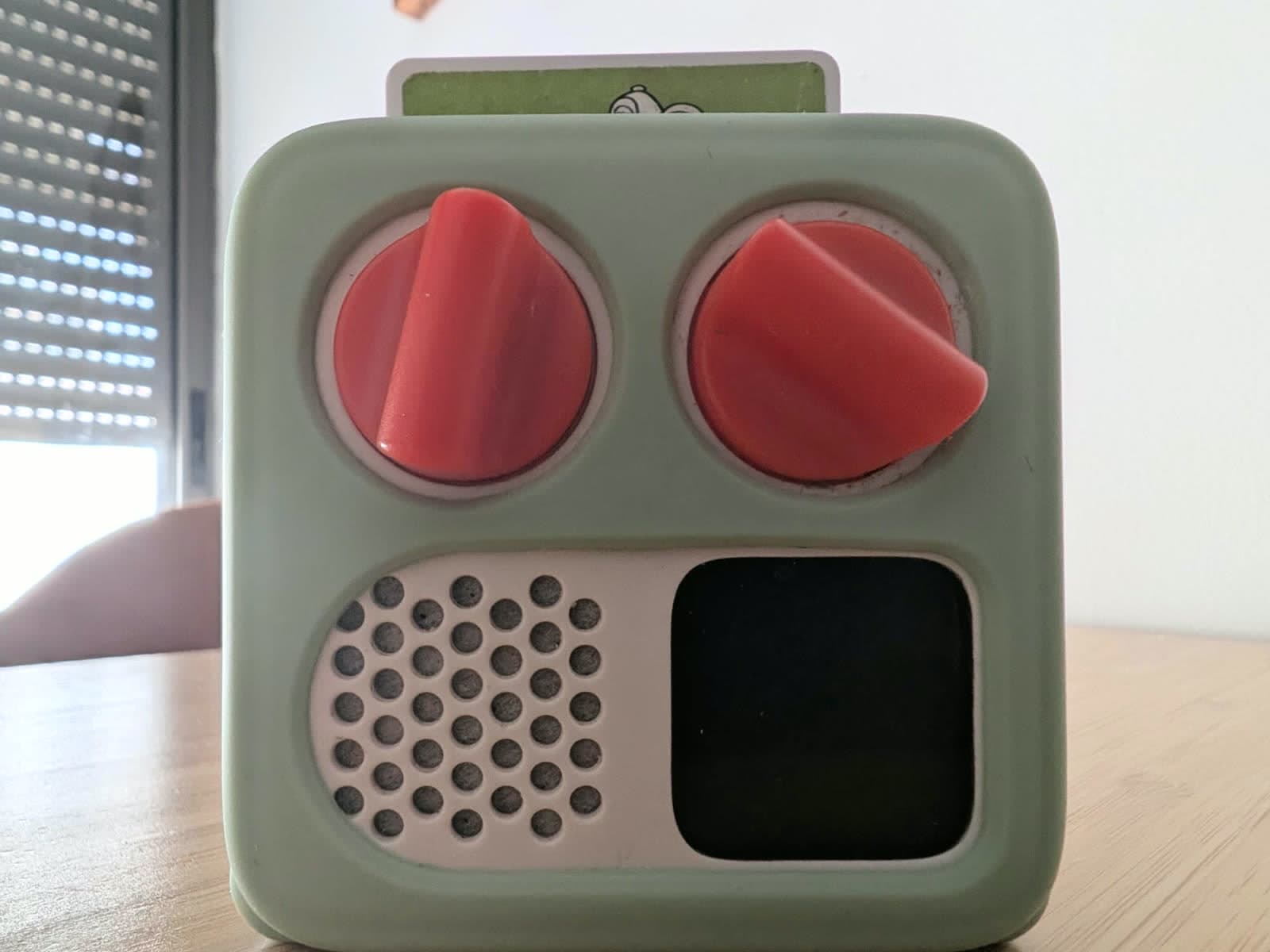
A year and a half in
We're genuinely happy with it. The moment that made it feel like the right call came at about two years and two months, when she started going to the box, choosing a card herself, and putting it in - no asking, no help. That's the whole promise of these things, and the Mini delivered it early.
The one thing we notice is the screen. She calls songs by whatever is drawn on the icon - the whale one, the rocket one - so on the Mini, where the screen is a small square in the corner, that is something she looks at while holding the player rather than spots from across the room. It matters less than we expected, because the Mini gets picked up anyway. But it is exactly why we care so much about icons being legible at actual size - on a screen that small, a vague one is no use at all.
What we'd tell a friend
Start with the Mini if your child is small, if it's going to travel, or if you'd rather not think about the price when it gets dropped. Start with the Player if it's going to live on one shelf, if bedtime is the main use and you want the nightlight, or if your child is old enough to want to see what's playing from across the room.
We're buying her the full-size one for her third birthday - probably the new 4th Gen Player. Both decisions were right, a year and a half apart - which is really the honest answer to this comparison.
Quick answers
- What is the difference between Yoto Player and Yoto Mini?
- The Mini is $79.99, with a small corner screen, one mono speaker and up to 14 hours of battery. The Player is $109.99, with a large front screen, a louder stereo speaker, up to 16 hours, a nightlight and a room thermometer. Both hold 32GB, and both play the same cards.
- Is the Yoto Mini the same as the regular Yoto Player?
- No, but they are closer than they used to be. Same cards, same app, same 32GB of storage. The Mini is smaller, cheaper and quieter; the Player is louder, has the big screen, the nightlight and the thermometer.
- Do Yoto cards work in both the Player and the Mini?
- Yes. Cards and Make Your Own cards work in either, so nothing you buy is tied to one model.
- Should I buy the Yoto Mini or the full-size Player?
- The Mini suits younger children, travel, and handing over without worrying about the price. The Player suits one room, bedtime, and children old enough to read the screen from across the room.
- What age can a child use a Yoto on their own?
- Ours was choosing and loading her own cards at two years and two months. There is no reading involved, so it comes down to whether they can handle the card and the buttons.