

Yoto vs Toniebox gets argued constantly, usually by someone who has only owned one of them. They're both screen-free audio players for children and that's roughly where the similarity stops. The difference in philosophy is much bigger than the spec sheets suggest, and it matters more than any individual feature.
Short answer: the usual advice is Toniebox under about four, Yoto from four or five, and it is decent advice. We ignored it and bought a Yoto for a two-year-old, and that has worked out fine too. Everything below is the reasoning, and where the rule of thumb breaks.
Quick disclosure: this is a Yoto site, so we obviously like Yoto. We still think the Toniebox is the better buy for a lot of families, and we'll say why.
The one-line version
Toniebox is a soft fabric cube. You put a little painted figurine on top and it plays that story. No screen, no buttons to speak of, nothing to read.
Yoto is a small speaker with a slot. You post a card in and it plays. It has a little pixel screen showing an icon for the current track, and it doubles as a clock, a nightlight and a radio.
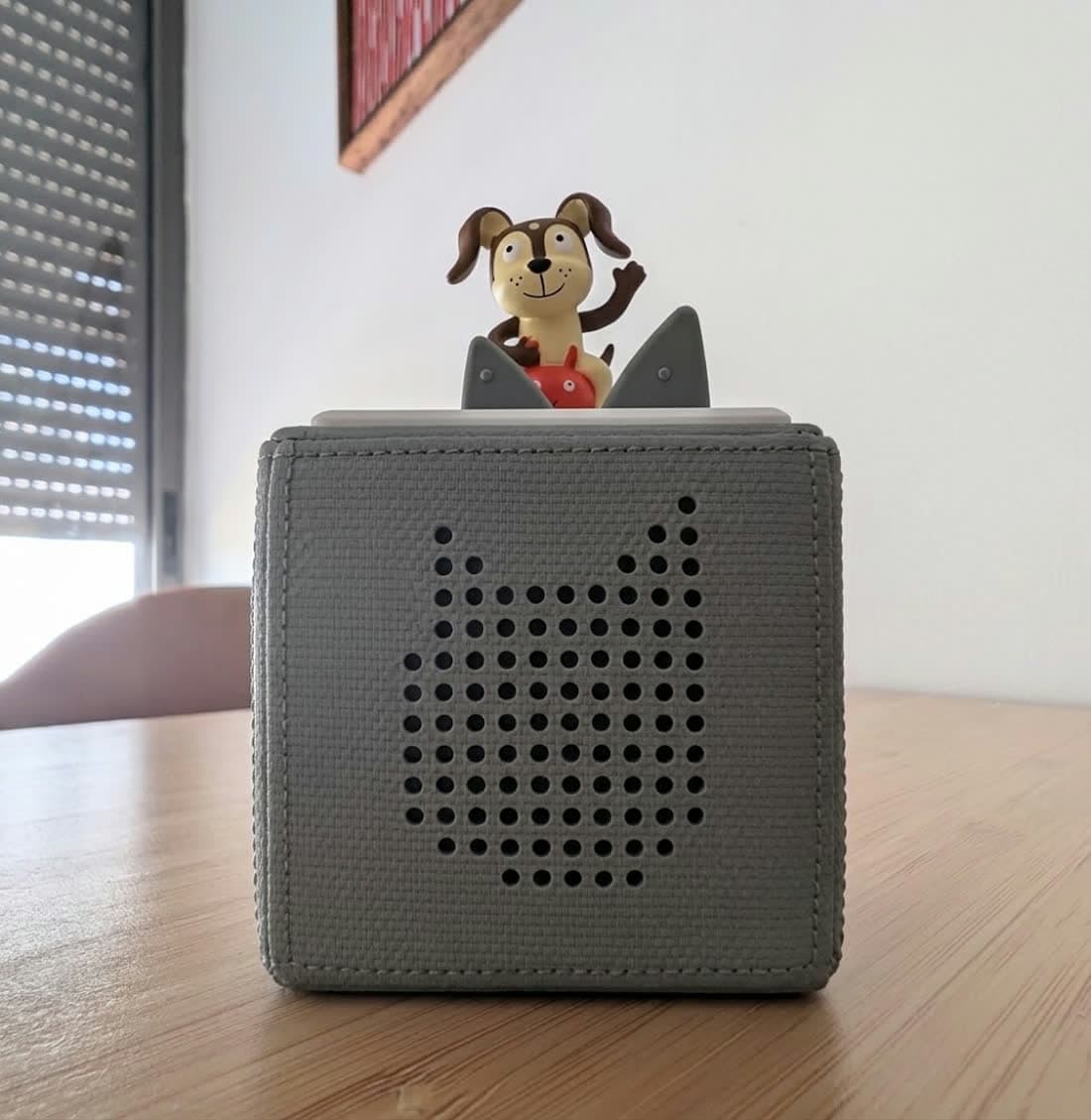
Toniebox is simpler. Yoto does more. Which of those is a feature depends entirely on the age of your child.
Yoto vs Toniebox at a glance
| Yoto | Toniebox | |
|---|---|---|
| How you play something | Post a card into a slot | Put a figurine on top |
| Screen | Yes, a pixel screen showing a track icon | None |
| Usual age advice | Around four and up | Around one to four |
| Your own audio | Make Your Own cards, sold in packs, very little each | Creative-Tonies, a figurine-sized purchase each |
| Tinkering around it | Custom icons, printed labels, shared playlists, small tools | Mostly painted figurines and storage |
| Also does | Clock, nightlight, ok-to-wake, radio, sleep sounds | Audio only |
| Storage | A box of flat cards | Shelf space for figurines |
| Travel | Cards are flat; the Yoto Mini is pocketable | Box plus a bag of figurines |
| Durability | Cards bend and go missing | Soft fabric, shrugs off drops |
| Lose the thing | MYO playlist survives; link a new blank card | Story gone until you buy another figurine |
Age, and the under-four rule of thumb
The common conception is that under about four you want a Toniebox, and the reasoning behind it is sound. A figurine is an obvious, chunky, tactile thing. There is exactly one way to use it and you can work it out at eighteen months. The box is squashy and survives being thrown down a flight of stairs. Nothing has a slot to post a raisin into.
Somewhere around four or five the balance shifts. Cards are flat, so a hundred of them fit in a box that a hundred figurines wouldn't. A child who can recognise pictures can flick through cards and choose, which is a genuinely different feeling from being handed a figurine. And the screen starts earning its keep - the clock matters when “stay in bed until it's yellow” becomes a household rule.
We went against that advice. We bought a Yoto for our own two-year-old and it has worked out fine. Posting the card turned out to be the appeal rather than the obstacle - it is a satisfying thing to do and they worked it out in a day. The cards have survived. Nothing has been posted into the slot that shouldn't have been.
So the under-four rule is a tendency, not a law. If the rest of the Yoto case appeals to you - the cheap Make Your Own cards, the clock, the travelling - a two-year-old is not on its own a reason to rule it out.
The bit where they really diverge: making your own
Both let you put your own audio on. The experience is not comparable.
Tonies has Creative-Tonies: blank figurines you record onto. They're lovely, and each one is a figurine-sized purchase, which puts a natural ceiling on how many you make.
The two systems share nothing, incidentally. A Tonies figurine will not work on a Yoto player and a Yoto card will not work on a Toniebox. There is no adapter and there is not going to be one.
Yoto has Make Your Own cards, which come in packs and cost very little each. You can load an entire audiobook, split into chapters, and give each chapter its own icon. If you want a card of Granny reading three stories, one of the school concert, and one of every song your child loved aged three, that's an evening's work and not much money.
This is the single biggest practical difference, and if you're the sort of person reading an article about custom icons, it's probably the one that decides it for you.
The maker thing
The part nobody puts in a comparison table is that Yoto has grown a making culture around it, and the Toniebox largely has not.
Because a Make Your Own card is cheap and its contents are just a playlist you control, everything downstream of it became something people tinker with. Parents draw 16×16 pixel icons for individual tracks. They print labels so a stack of identical white cards stops being identical. They swap playlists, argue about how to split an audiobook into chapters, and build small tools for the fiddly parts. None of that is officially organised. It happens because the format leaves room for it.
Tonies has crafters too - painted figurines, custom cases - but it is making things around the object. Yoto's is making the content itself, which is a different hobby and a more useful one, because what you produce is a card your child actually plays.
We are not a neutral witness here. This entire site is a symptom of it: a free icon library, playlist ideas for MYO cards, and printable card labels, none of which Yoto asked anyone to build. If that sounds like your idea of a good evening, it is a real point in Yoto's favour. If it sounds like a chore you would rather not have, that is a genuine argument for the Toniebox - a figurine works perfectly the moment you take it out of the box, and nothing about it invites a project.
Content
Tonies has the stronger licensed catalogue in a lot of markets, and the figurines are genuinely beautiful objects. Children display them. They get given as presents. There's a collecting instinct at work that cards don't quite trigger.
Yoto's catalogue is large and it includes a lot of full-length audiobooks, plus podcasts, music and daily content that refreshes without you buying anything. The Yoto Club subscription drip-feeds new titles, which some families love and others find is just another subscription.
Worth checking what's actually available where you live before you commit. Both catalogues vary by country and the thing your child is obsessed with may only be on one of them.
Living with them
Storage. Figurines need shelf space and they fall over. Cards need a box. After two years of collecting, cards win comfortably.
Travel. Cards are flat and the Yoto Mini is genuinely pocketable. A Toniebox plus a bag of figurines takes up real luggage.
Durability. The Toniebox is squashy fabric and shrugs off drops. Yoto cards bend, get chewed, and disappear behind furniture. Both survive normal family life; the Toniebox survives more.
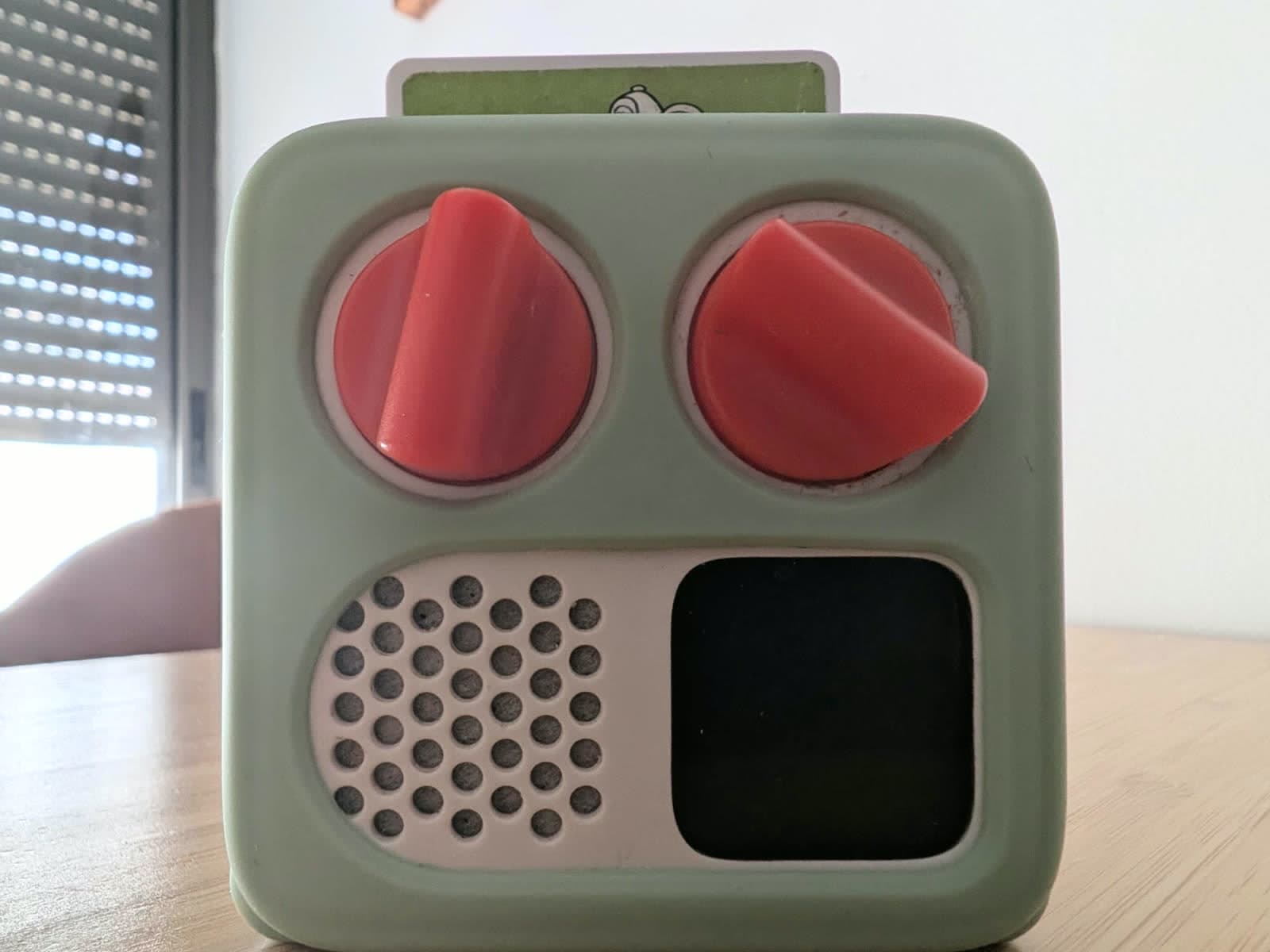
Losing things. Lose a figurine and you've lost the story until you buy another. Lose a Make Your Own card and the playlist is still in your account - you link a new blank card and you're back. Lose a bought Yoto card and you're in the same boat as the figurine.
The extra Yoto features. The clock, the nightlight, the ok-to-wake colour, the radio, the sleep sounds. Some households use all of it daily and would miss it enormously. Others never touch any of it. Be honest with yourself about which you are.
So which one
Get a Toniebox if your child is under about four, if you want something indestructible, or if the tactile figurine thing appeals to you - for a lot of small children the object in the hand is most of the magic.
Get a Yoto if your child is four or older, if you want to make your own cards without thinking about the cost each time, if you travel, or if the clock and nightlight would genuinely earn their place on the bedside table. And get one anyway if those things appeal and your child is younger - ours was two and it was the right call.
If you land on Yoto, there is one more decision waiting: the full-size Player or the Mini. Same cards either way, so it is a smaller decision than this one.
And the unhelpful but honest answer: plenty of families end up with both, usually a Toniebox for the younger one and a Yoto for the older. They coexist fine. Nobody has ever regretted a screen-free audio player.
Quick answers
- Is Yoto or Toniebox better for a toddler?
- The common conception is that under-fours want a Toniebox: it is soft, nearly indestructible, and a figurine has only one way to use it. It is a tendency rather than a law - we bought a Yoto for our two-year-old and posting the card turned out to be the appeal rather than the obstacle.
- What is the difference between Yoto and Tonies?
- A Toniebox plays a figurine placed on top and has no screen. A Yoto plays a card posted into a slot, shows a pixel icon for the current track, and also works as a clock, nightlight and radio.
- Which is cheaper for making your own content?
- Yoto. Make Your Own cards come in packs and cost very little each, whereas Creative-Tonies are a figurine-sized purchase every time.
- Can you use Tonies figurines on a Yoto player?
- No. They are separate systems with no crossover. Tonies work only on a Toniebox and Yoto cards only on a Yoto player, and neither company sells an adapter.
- Which is better for travelling?
- Yoto. Cards are flat, so a whole collection fits in a small box, and the Yoto Mini is pocketable. A Toniebox plus a bag of figurines takes real luggage space.
- Is it worth having both a Yoto and a Toniebox?
- Plenty of families do, usually a Toniebox for the younger child and a Yoto for the older one. They coexist fine and share no content, so it is two separate libraries to buy.